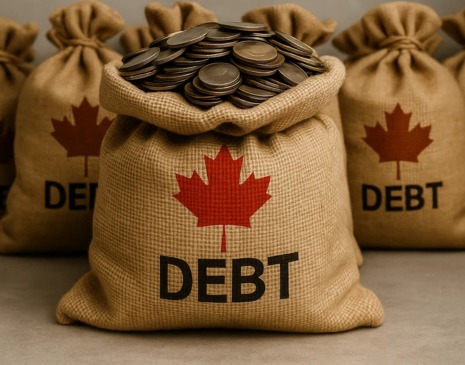

Young Canadians didn’t sign up to be a credit card for the federal government. With every deficit, future generations are forced to pick up the tab for politicians who don’t stop spending.
The Canadian government has developed an addiction to debt and overspending. The recklessness of overspending isn’t just about what’s unsustainable today; it’s about the future of young Canadians like myself. What’s most frustrating about overspending is that debt is no longer a last resort; it’s treated as an accessory to any progress.
On a personal level, borrowing money comes with scrutiny. If I go to my bank for a loan, I need to prove I can pay it back, sign paperwork, and have my credit score checked. Even then, I hesitate for a second because I know debt has real consequences within my lifetime. Meanwhile the federal government signs off on billions in debt like it’s just another day at the office. It’s reckless.
It’s not only the amount of money we’re borrowing, it’s what we’re borrowing it for. Canada continues to spend heavily on foreign aid, with a Trudeau-era plan announced in March for a total of $272.1 million in funding for 14 projects in Bangladesh and the Indo-Pacific region. We thought it’d change with the new “austerity” budget, but now Secretary of State for International Development MP Sarai announced $77.6 million in funding for projects in Peru and Colombia. Then $60 million for Haiti.
Bringing it back to a personal level, when you plan your charitable contributions for the year, are you considering taking out loans to do it? Of course not. You give what you can afford and contribute your excess. Yet our federal government is borrowing money to make these international contributions. This is generosity that future generations will need to repay. On a micro scale, it makes no sense. On a macro scale, it still makes no sense.
Deficits might feel abstract, like they’re just numbers and it’ll work itself out. Justin Trudeau famously said that the budget will “balance itself.” Now, years later, the budget still hasn’t balanced itself. The hard truth is that budgets don’t balance themselves, but debt compounds and young Canadians are on the hook for it.
While we can grow out of debt in time, future generations can just as easily grow into it. The reality is that these governments aren’t going to pay back the debt during their tenure, and they never planned to. Even worse, as the debt climbs, so will the amount we pay to service the debt. The 2024-2025 Main Estimates show that the public debt charges for just this year is $52.1 billion and is forecasted to rise to $62.0 billion by 2028-2029.
The PBO in their recent report expects our debt service ratio to rise to 10.7% in 2024-2025. This means that 10.7% of every federal tax dollar goes straight to servicing our debt. 10 cents on every dollar, gone instantly.
How long until that 10% becomes 11%, then 12%, and keeps rising? Well the PBO told us, they expect this to increase to 13.7% in 2030-31.
With every deficit we run, we give up more flexibility, robbing future Prime Ministers and young Canadians of the chance to invest in their own priorities.
Fraser Institute projected that if you’re a 16-year-old Canadian in 2025, you’re going to pay an estimated $29,663 over your lifetime towards the debt; if you’re 65, you’ll pay an estimated $2,433. These numbers show that the youth today are worse off because of the federal debt. Our tax dollars won’t go towards the programs we need because of the federal debt.
Our leaders are spending like crazy and are sending the bill to young Canadians. Those who can’t even vote today will feel the strain tomorrow if we don’t rein in our spending, but it doesn’t have to be this way. Governments in the past, while not many, have run balanced budgets. Debt doesn’t have to be an accessory to progress.
We know it’s possible. If there’s the will. Now it’s up to our elected government to put Canadians first.
Ryan Comeau is a Contributor at TrendingPolitics.ca