
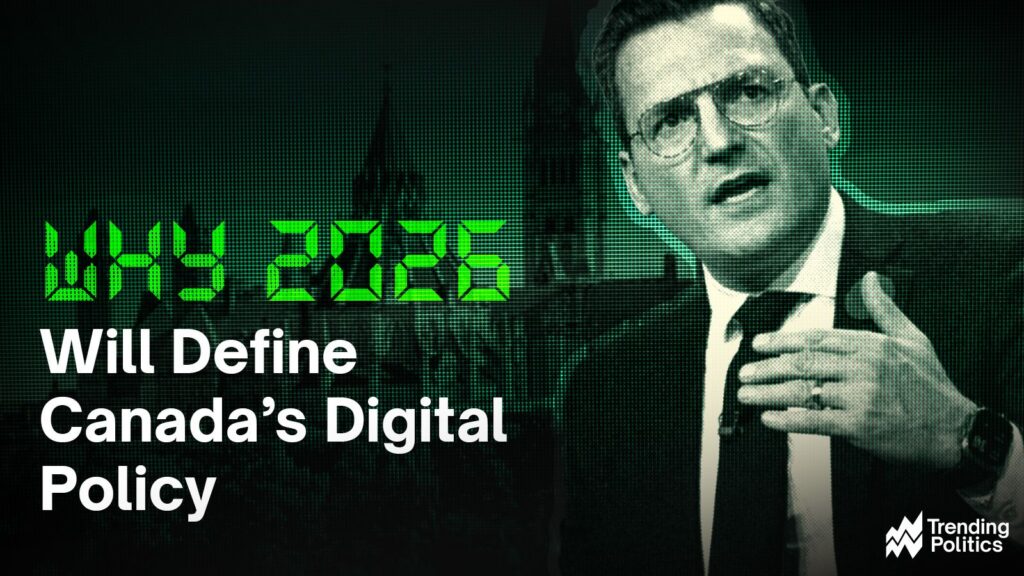

If 2025 was the year of technology hype, then 2026 will need to be the year of action.
The federal government and key ministers have set ambitious 2026 timelines for tech policy, which will quickly turn hype into haste. The Carney government will roll out three key pieces of tech policy over the next few months, driven by several self-imposed goals: a new AI Strategy, AI and Privacy legislation, and the Definition of Digital Sovereignty.
A New AI Strategy
After a national “AI Sprint” in which 11,000 consultation submissions were received at the end of November 2025, the government will need to put forward a national AI strategy to chart Canada’s path forward into a new digital age. While Minister Solomon had hoped to have the strategy out by the end of 2025, Canadians are still waiting for its official release.
The Pan-Canadian AI Strategy, released in 2017 by the Trudeau government, provided funding to organizations to support talent recruitment, establish National Artificial Intelligence Institutes, and advance AI adoption standards. As Canada now enters 2026, we are in desperate need of an update. Updating this strategy would be less like making a tweak and more like upgrading from Windows 95 to Windows 11. Canada needs a new plan that aligns with the new digital age.
Digital Ministers from the G7 met in Montreal in December to discuss the adoption of AI within their countries. Canada also unveiled its SME AI Adoption Blueprint, which outlined key policy recommendations, including financing, increased AI literacy, and regulatory certainty. This document could be seen as a signal of what is to come in the AI strategy, but details on the overall AI strategy document remain loose.
Minister Solomon recently appeared before the Science and Research Committee, where he presented his task force’s “what we heard document, which was largely a continuation of previous communications. The Minister also promised to release the strategy “this quarter”.
AI and Privacy Policy
One thing we should expect early in the legislative calendar is new AI and Privacy legislation, which will mark Canada’s third attempt to refresh our existing Privacy legislation and second attempt to pass AI-specific legislation. The Trudeau government tried and failed to pass Bill C-27, a Frankenstein bill combining multiple priorities that sought to cover three distinct areas of digital policy (Consumer Privacy Protection, Personal Data, and Artificial Intelligence). Still, it collapsed under sustained criticism of the committee and was ultimately removed following prorogation.
Several organizations said that C-27 failed to meet innovation standards by capturing all technologies. The draft of the bill, had it received royal assent unamended, would reportedly have stifled innovation and investment here in Canada. There were also red flags, as the legislation deviated from global privacy standards, risking Canada’s international trade and partnerships.
The lesson from C-27 is clear: the next bill must be narrower, more precise, and aligned with global standards. Minister Solomon will need to balance innovators’ freedom, citizens’ fears, and consumers’ privacy.
Solomon’s recent appearance before the Science and Research committee also highlighted his commitment to releasing new privacy legislation “soon”.
Digital Sovereignty
While Canada looks to create its own “sovereign digital infrastructure,” including more data centers here that would be subject to Canadian law, Solomon must also square this with his commitment to “sovereignty, not solitude.”
As Solomon works to define digital sovereignty, he must balance Canadians’ need for their data to be stored in Canada without creating an environment in which the government imposes increased costs and regulations on doing business here. A September report released by the Leaders Fund highlights that Canadian founders are continually building their businesses in other countries, notably the United States. At a time when companies are fleeing, Canada’s digital sovereignty agenda must attract investment, not deter it.
Solomon noted that “sensitive” data must be covered under Canadian law, but a key feature of the digital policy discussion will be defining what constitutes “sensitive” data. It will be critical to make this distinction to ensure Canadians’ privacy is protected without kneecapping data flows.
As the House of Commons is now back in full swing. policymakers will be asked to answer the question of where Canada will head as it charts its digital future. By the end of 2026, Canada will have new directions in these three distinct areas that may answer the question of whether it will be easier or harder for tech businesses in Canada.
Chase Tribble is a Senior Consultant at Counsel Public Affairs Inc.