
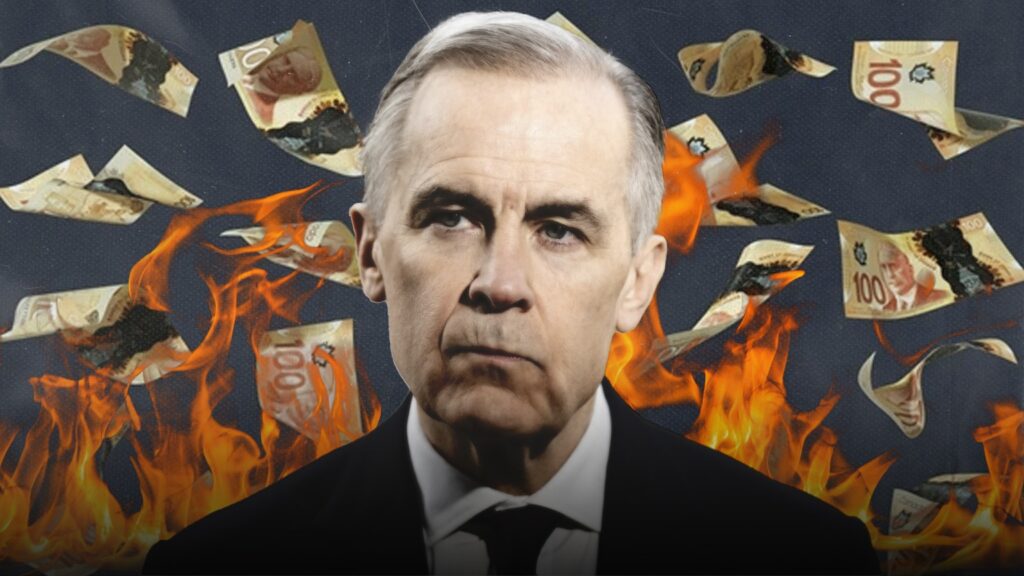

According to the Parliamentary Budget Officer, Prime Minister Mark Carney’s new Groceries and Essentials Benefit—an expanded version of the federal GST credit—will come with a price tag of $12.4 billion over the next four years. While the prime minister talks about “austerity,” in reality, he’s increased federal spending and debt.
In fact, Carney plans to spend more and rack up more debt than his predecessor, Justin Trudeau, had planned. According to Carney’s first budget released in November, between 2025/26 and 2028/29, the government plans to spend $63.4 billion more than Trudeau had planned and more than double Trudeau’s projected deficits (which of course add to federal debt).
Carney says Canadians shouldn’t worry about the debt, and his government wants to shift the “fiscal debate from ‘how much’ we borrow to ‘why’ we borrow” with a focus on “ensuring that public dollars back high-impact actions with lasting economic returns.” This claim doesn’t stand up to scrutiny.
To start, it matters how much the federal government borrows, regardless of the “why.” Taxpayers pay for government spending, including interest payments on Ottawa’s debt. In 2024/25, the federal government spent $53.8 billion on debt interest, equal to $1,320 per Canadian. That’s $53.8 billion unavailable for important services (e.g. defence) or returned to Canadians through tax relief. And Carney’s planned borrowing means debt interest costs will likely increase in the coming years.
Additionally, government debt has consequences beyond the direct cost to taxpayers. High levels of government debt can increase total demand for lending, which can drive up interest rates and discourage business investment. When businesses invest less in machinery, equipment and other assets that can help increase worker productivity, worker incomes may suffer. One recent study found that if governments across Canada reduced their debt-to-GDP ratios (an indicator of a government’s ability to pay its debt) to pre-pandemic levels, the resulting boost in productivity could raise annual incomes for the average full-time worker by $2,100. Carney’s additional borrowing will move debt levels in the opposite direction, conflicting with his goal of making lasting improvements to Canada’s economy.
In short, how much we borrow matters.
But let’s also consider the second part of Carney’s claim—that we should focus on why we borrow. Is Carney’s spending all going toward “high-impact actions with lasting economic returns”? No, it’s not. And the new Groceries and Essentials Benefit is a perfect example. This benefit, enacted in early 2026, provides money to “low-income” households and individuals to purportedly offset the cost of the GST (or HST in certain provinces) and help with affordability. This year, a family of four can receive up to $1,890, and a single person can receive up to $950. While many Canadians struggle with the cost of living, spending more on government transfers will do little to boost economic growth. Moreover, many recipients of this benefit don’t need it. For example, more than 10 per cent of recipients of the GST credit in 2021 were young people living with their parents in households with incomes of at least $100,000 a year.
Certain types of government spending—such as investments in roads or ports that facilitate trade—can help produce long-term economic benefits. But much of Carney’s current spending isn’t growth-inducing. And it’s misleading for the government to argue that a massive deficit is necessary to invest in future growth, then spend $12.4 billion on expanding a poorly targeted social program. The prime minister has also renewed hundreds of millions in spending for ineffective and poorly targeted electric vehicle rebates despite evidence showing EV purchases are typically made by affluent Canadians.
When it comes to Prime Minister Carney’s spending and borrowing plans, Canadians should be worried about both the “how much” and the “why.”
Jake Fuss is director of fiscal studies and William Dunstan is a junior analyst at the Fraser Institute.